

Why Online Reviews Are Key to Your Law Firm’s Growth
With so many people turning to digital platforms to judge credibility, managing partners at mid-sized personal injury firms face an urgent challenge.
Knowing how to optimize and manage online reviews can help American law practices stand out, attract more clients, and build lasting reputations rooted in genuine client satisfaction.
Understanding Online Reviews for Law Firms
Online reviews have become a critical factor in determining a law firm’s success in attracting potential clients. Prospective legal clients increasingly rely on digital testimonials and ratings to evaluate the credibility and performance of law firms before making representation decisions.
According to FTC guidelines on consumer reviews, these digital recommendations provide crucial insights into a firm’s reputation and client satisfaction.
Reviews serve multiple strategic purposes for law firms. They function as social proof, allowing potential clients to gauge a firm’s expertise, communication skills, case success rates, and overall client experience.
Positive reviews can significantly influence a potential client’s decision to schedule a consultation, while negative reviews can deter prospects from engaging legal services.
The Federal Trade Commission emphasizes the importance of authentic, transparent reviews that accurately reflect genuine client experiences.
The digital landscape of legal reviews involves multiple platforms, including Google Business Profile, Avvo, Yelp, and specialized legal directories.
Each platform offers unique opportunities for law firms to showcase client testimonials and build digital credibility. Law firms must actively manage their online reputation by encouraging satisfied clients to share their experiences, promptly addressing negative feedback, and maintaining a consistent, professional online presence.
Law firm reputation management strategies can help firms effectively navigate these digital review ecosystems.
Pro tip: Implement a systematic approach to requesting client reviews immediately after successful case resolutions, ensuring timely and authentic feedback collection.
Types of Reviews and Key Platforms
Law firms encounter diverse review platforms that offer unique opportunities for showcasing client experiences and professional reputation.
Legal review platforms range from specialized legal directories to general consumer review sites, each providing distinct mechanisms for client feedback and professional evaluation. These platforms include professional networks like Avvo, general review sites such as Google Business Profile, and industry-specific directories like Martindale-Hubbell.
The primary types of reviews for law firms can be categorized into several key classifications. Client Testimonials represent direct narrative feedback from individuals who have experienced the firm’s services, typically featuring detailed accounts of case outcomes and personal interactions.
Star Ratings provide quick visual representations of overall satisfaction, allowing potential clients to quickly assess a firm’s performance.
Peer Reviews offer professional evaluations from other attorneys, which can be particularly valuable in demonstrating professional credibility and expertise.
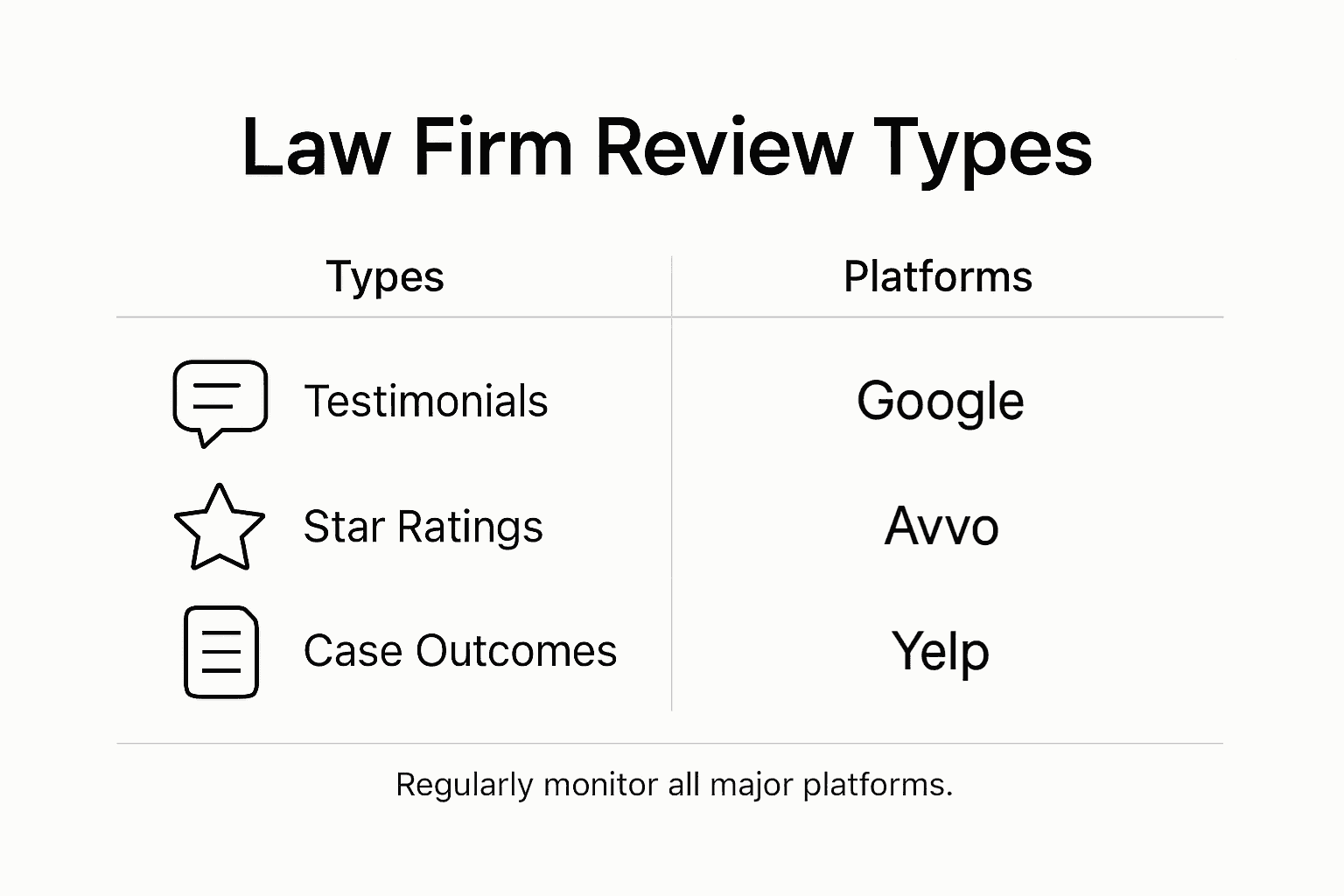
Each review platform has specific characteristics that law firms must understand to maximize their digital reputation. Google Business Profile offers broad visibility and impacts local search results, while Avvo provides detailed attorney profiles with specialized legal ratings.
Yelp focuses on consumer experience, and industry-specific platforms like Martindale-Hubbell emphasize professional credentials and peer recommendations.
Understanding the nuanced differences between these platforms allows law firms to develop targeted strategies for managing their online presence effectively.
Here’s a comparison of major law firm review platforms and their unique advantages:
| Platform | Audience Reach | Distinct Feature | Typical Review Content |
|---|---|---|---|
| Google Business | Very High | Impacts local search results | Public ratings, brief text |
| Avvo | Legal professionals | Detailed profiles and ratings | Attorney expertise, cases |
| Yelp | General consumers | Focus on user experience | Service quality |
| Martindale-Hubbell | Legal industry | Peer and client reviews | Ethics, credentials |
Pro tip: Develop a comprehensive review management strategy that includes monitoring multiple platforms and creating a systematic approach to encouraging authentic client feedback.
Effects on Client Trust and Firm Reputation
Online reviews play a pivotal role in shaping client trust and a law firm’s professional reputation.
When potential clients encounter detailed, genuine reviews, they develop a more nuanced understanding of a firm’s capabilities, communication style, and track record of success.
The impact of reviews extends beyond mere ratings. Potential clients analyze the depth, consistency, and specificity of testimonials to evaluate a law firm’s expertise. Detailed reviews that describe specific case outcomes, attorney responsiveness, and client experiences provide social proof that can be more persuasive than traditional marketing materials.
Conversely, negative or fabricated reviews can rapidly erode trust, potentially deterring prospective clients from engaging a law firm’s services.
Law firms must recognize that modern clients view online reviews as a critical component of their decision-making process. Ethical review management involves not just collecting positive feedback, but maintaining transparency, addressing negative reviews constructively, and demonstrating a commitment to client satisfaction.
The Federal Trade Commission emphasizes the importance of genuine, unmanipulated reviews that accurately represent client experiences, highlighting the need for authentic digital reputation management.
Pro tip: Implement a proactive review collection process that encourages satisfied clients to share detailed, honest feedback while maintaining strict ethical standards.
How Reviews Influence Local SEO Rankings
Local search engine optimization represents a critical strategy for law firms seeking to improve their digital visibility in geographic markets. Reviews serve as a powerful signal to search engines, directly impacting a firm’s local search rankings and online discoverability.
Google’s algorithm considers review quantity, quality, recency, and diversity when determining a law firm’s placement in local search results, making them a fundamental component of digital marketing strategy.
The mechanics of review influence on local SEO are nuanced and multifaceted. Positive reviews contribute to improved Google My Business rankings by demonstrating client satisfaction and engagement. Search engines interpret multiple high-quality reviews as indicators of credibility, relevance, and trustworthiness.
Law firms with consistent, detailed reviews that include location-specific keywords can significantly enhance their chances of appearing in the coveted Local Pack – the top three local business listings displayed in search results.
Beyond numerical rankings, reviews offer qualitative signals that search algorithms consider. Detailed reviews mentioning specific practice areas, case types, and local geographic references provide contextual relevance that improves organic search performance. Law firms should encourage clients to write comprehensive reviews that naturally incorporate location-based terms and specific legal service descriptions.
Understanding search engine ranking factors can help firms strategically optimize their review collection and management processes.
Summary of how online reviews influence law firm outcomes:
| Review Factor | Impact on Law Firm | Search Engine Effect |
|---|---|---|
| Quantity of Reviews | Increases client trust | Boosts local rankings |
| Review Detail | Shows expertise | Improves relevance |
| Recency | Signals active practice | Favors ranking freshness |
| Location Keywords | Enhances local credibility | Optimizes location SEO |
Pro tip: Develop a systematic approach to collecting client reviews that emphasizes detailed, location-specific feedback while maintaining ethical standards of authenticity.
Managing Negative Feedback and Compliance
Federal Trade Commission regulations establish critical guidelines for law firms managing online reviews, emphasizing the importance of transparent and ethical feedback practices. Negative reviews represent an opportunity for professional growth and client relationship management, rather than a threat to be suppressed.
Law firms must develop a strategic approach that addresses critical feedback constructively while maintaining legal and ethical standards.
Responding to negative reviews requires a nuanced, professional strategy. Each negative review should be approached as a chance to demonstrate the firm’s commitment to client satisfaction and continuous improvement.
Transparent communication is key, involving a measured response that acknowledges the client’s concerns, offers to address specific issues, and demonstrates the firm’s dedication to resolving potential misunderstandings. Professional responses can potentially transform a negative experience into a positive perception of the firm’s client service approach.
Comprehensive review management involves more than just responding to individual feedback. Law firms must implement systemic processes that prevent review manipulation, ensure compliance with FTC guidelines, and maintain the integrity of their online reputation.
This includes establishing clear protocols for requesting reviews, training staff on appropriate response techniques, and developing a consistent approach to addressing both positive and negative client feedback. The goal is to create a transparent, honest representation of the firm’s client experiences that builds trust and credibility.
Pro tip: Create a standardized internal protocol for reviewing and responding to client feedback that emphasizes empathy, professionalism, and a genuine commitment to client satisfaction.
Boost Your Law Firm’s Growth with Strategic Review Management
The challenge many legal practices face is turning authentic client feedback into a powerful marketing asset while navigating negative reviews ethically. Many firms struggle to implement a systematic review collection and response strategy that enhances visibility and attracts quality leads in competitive markets.
At LawSmiths, we understand the critical role reviews play in shaping your firm’s digital presence. Our full-service digital marketing solutions are designed specifically for law firms ready to leverage authentic client feedback to improve search rankings, build trust, and convert prospects into clients.
Whether you want to optimize your local SEO strategy or develop a consistent approach to managing online reviews, our expertise in SEO, web design, and reputation management ensures your firm stands out.
Call (833) 217-2991 for a free law firm reputation management consultation and take the first step toward elevating your law firm’s digital influence and client acquisition.
Frequently Asked Questions
How do online reviews influence a law firm’s reputation?
Online reviews serve as social proof, allowing potential clients to gauge a law firm’s expertise, communication skills, and overall client experience. Positive reviews can enhance credibility, while negative reviews may deter prospects.
What types of reviews are most impactful for law firms?
Key types of impactful reviews include client testimonials that detail personal experiences, star ratings that provide a quick visual assessment of satisfaction, and peer reviews from other attorneys that affirm professional credibility.
How can law firms effectively manage their online reviews?
Law firms can effectively manage their online reviews by encouraging satisfied clients to leave feedback, promptly addressing negative reviews, and maintaining a consistent online presence across multiple platforms.
Why are client reviews important for local SEO rankings?
Client reviews are crucial for local SEO as they signal trust and engagement to search engines. Factors such as review quantity, quality, and recency directly influence a firm’s placement in local search results, impacting online discoverability.

