

How Top Law Firms Use Advertising Campaigns to Explode Client Growth
Every law firm faces the challenge of standing out while maintaining professional integrity. As competition for client acquisition intensifies, the need for targeted communication that reflects both legal expertise and ethical standards has never been greater.
This guide offers practical strategies for developing law firm advertising campaigns that balance compelling outreach with regulatory requirements, empowering marketing managers to attract quality clients and build lasting credibility.
Defining Law Firm Advertising Campaigns
Law firm advertising campaigns represent strategic marketing efforts designed to attract potential clients, build brand recognition, and ultimately grow legal practice revenue. Unlike traditional business marketing, legal advertising operates within strict ethical guidelines and professional regulations.
Legal advertising historically emerged after a pivotal 1977 Supreme Court ruling that affirmed attorneys’ constitutional rights to promote their services.
These campaigns encompass multiple channels and strategies specifically tailored to legal professionals, including:
- Digital marketing tactics
- Social media engagement
- Targeted online advertisements
- Content marketing initiatives
- Reputation management efforts
Successful law firm advertising campaigns require a nuanced understanding of both marketing principles and legal professional standards. The American Bar Association emphasizes that advertising should simultaneously inform potential clients and maintain the dignity of legal practice. This means creating messaging that is both compelling and professionally appropriate.
Modern law firm advertising strategies focus on demonstrating expertise, building trust, and communicating unique value propositions. Targeted communication becomes critical, with campaigns designed to speak directly to specific legal service needs.
Digital marketing services now play a central role in reaching potential clients through sophisticated, data-driven approaches.
Pro tip: Develop advertising content that educates potential clients while subtly highlighting your firm’s specialized expertise and proven track record.
Key Campaign Types and Approaches
Law firms leverage multiple advertising campaign types to reach potential clients and differentiate their legal services in a competitive marketplace. Legal advertising strategies encompass a diverse range of approaches tailored to specific practice areas and target demographics.
Key campaign types include:
Digital Marketing Campaigns
- Search engine optimization (SEO)
- Pay-per-click (PPC) advertising
- Social media marketing
Content-Based Campaigns
- Legal blog development
- Video content marketing
- Informational website resources
Local and Targeted Campaigns
- Geographically focused advertising
- Practice area-specific messaging
- Reputation management strategies
Specialized Practice Areas require nuanced marketing approaches. Personal injury firms often utilize high-visibility advertising channels like television and digital platforms, while criminal defense and family law practices might employ more targeted, discrete marketing strategies. Legal advertising approaches vary significantly based on practice specialization and local market dynamics.
Successful law firm advertising demands a sophisticated understanding of both marketing principles and legal professional ethics. Campaigns must balance compelling messaging with regulatory compliance, ensuring that potential clients receive accurate, transparent information about available legal services.
Pro tip: Develop multi-channel marketing strategies that leverage both digital and traditional advertising platforms to maximize client reach and engagement.
Here’s a comparison of major law firm advertising campaign types and their strategic business impact:
| Campaign Type | Main Objective | Typical Outcome |
|---|---|---|
| Digital Marketing | Increase online visibility | Greater web inquiries |
| Content-Based | Educate and inform prospects | Enhanced thought leadership |
| Local/Targeted | Reach specific geographic audiences | Higher local client conversion |
Digital vs. Traditional Advertising Tactics
Law firms today face a critical decision in allocating marketing resources between digital and traditional advertising channels. Digital advertising offers unique measurement advantages through advanced data analytics platforms that enable precise targeting and performance evaluation.
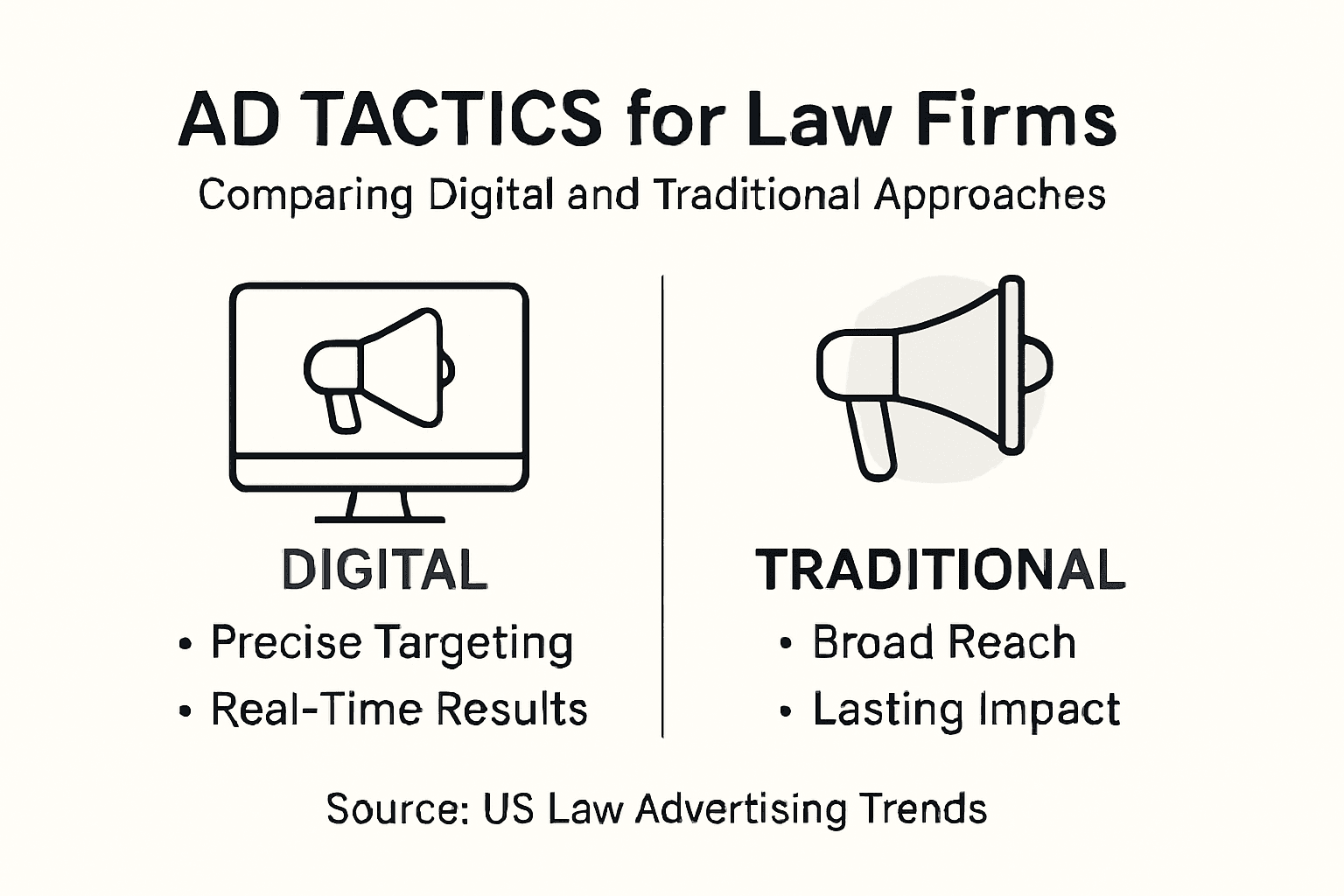
Key differences between digital and traditional advertising include:
Digital Advertising Strengths:
- Precise audience targeting
- Real-time campaign adjustments
- Lower cost per engagement
- Detailed performance tracking
- Immediate interaction capabilities
Traditional Advertising Strengths:
- Broader audience reach
- Emotional connection potential
- Higher visibility for older demographics
- Established credibility
- Tangible brand presence
Modern law firms increasingly recognize the importance of an integrated marketing approach. Marketing communications research suggests that blending digital and traditional tactics yields the most comprehensive client acquisition strategy. Digital platforms excel in targeted outreach, while traditional media maintains strong emotional engagement potential.
Successful advertising strategies require law firms to understand their specific target audience, practice area dynamics, and regional market characteristics. This nuanced approach allows for strategic resource allocation across multiple advertising channels, maximizing overall marketing effectiveness.
Pro tip: Create a balanced advertising portfolio that combines digital precision with traditional media’s broad emotional reach to optimize client acquisition.
Legal Rules and Ethical Compliance for Ads
Law firm advertising operates within a complex framework of ethical guidelines and professional standards designed to protect both consumers and the legal profession’s reputation. Lawyer advertising must adhere to constitutional standards while maintaining transparency and professional integrity.
Key ethical compliance requirements include:
Prohibited Practices:
- Making false or misleading statements
- Creating unjustified expectations about case outcomes
- Guaranteeing specific legal results
- Using deceptive imagery or language
Mandatory Disclosure Elements:
- Clear identification of advertising as solicitation
- Accurate representation of legal services
- Transparent fee structures
- Verification of professional credentials
Regulatory Compliance demands meticulous attention to detail. Ethical advertising rules specifically prohibit unauthorized use of competitor names and mandate careful review of all advertising content to prevent potential professional discipline.
Modern law firms must balance aggressive marketing strategies with strict ethical guidelines. This requires developing advertising materials that are both compelling and compliant, ensuring potential clients receive accurate information while maintaining the legal profession’s fundamental principles of integrity and professional responsibility.
Pro tip: Implement a comprehensive internal review process for all advertising materials, involving legal ethics experts to ensure full regulatory compliance.
Budgeting, ROI, and Risk Management
Law firm advertising requires strategic financial planning that balances marketing investment with potential client acquisition costs.
Advertising budget decisions involve complex analytical methods that aim to maximize profit while managing inherent marketing uncertainties.
Key financial considerations for law firm advertising include:
Budget Allocation Strategies:
- Percentage of total revenue method
- Competitive parity approach
- Performance-based budgeting
- Goal-driven investment model
- Historical performance analysis
Risk Management Components:
- Tracking cost per acquisition
- Monitoring conversion rates
- Evaluating channel performance
- Setting clear marketing objectives
- Establishing budget flexibility
Return on Investment (ROI) calculations become critical in determining advertising effectiveness.
Successful financial management in law firm advertising demands continuous monitoring, data-driven decision-making, and willingness to adapt strategies based on measurable outcomes. Firms must develop robust tracking mechanisms that provide transparent insights into marketing expenditure and client acquisition metrics.
Pro tip: Implement a quarterly review process that critically evaluates advertising spending against client acquisition metrics, allowing for rapid strategy adjustments.
Common Pitfalls and What to Avoid
Law firm advertising is fraught with potential regulatory and ethical landmines that can quickly derail marketing efforts. Advertising rules often create complex compliance challenges that require meticulous attention to detail and proactive risk management.
Common advertising pitfalls include:
Compliance-Related Risks:
- Making unsubstantiated legal claims
- Using misleading comparative statements
- Guaranteeing specific case outcomes
- Breaching confidentiality in marketing materials
- Violating state-specific advertising regulations
Ethical Marketing Mistakes:
- Misrepresenting professional credentials
- Exploiting emotional vulnerabilities
- Creating unrealistic client expectations
- Inappropriate use of client testimonials
- Failing to disclose potential limitations
Keyword advertising misuse represents another significant risk area for law firms. Attorneys must carefully navigate digital marketing strategies to avoid professional discipline and maintain ethical standards. This requires understanding complex jurisdictional nuances and maintaining strict adherence to professional advertising guidelines.
Successful law firms recognize that effective marketing requires a delicate balance between compelling communication and rigorous ethical compliance. Developing a comprehensive internal review process and staying current with evolving advertising regulations becomes crucial in mitigating potential risks.
Pro tip: Establish a multi-layer review process involving legal ethics experts to thoroughly vet all advertising materials before publication.
Accelerate Your Law Firm Advertising Success with Strategic Digital Marketing
Many legal practices struggle with navigating complex advertising rules while trying to stand out in a competitive digital landscape. Key pain points include reaching the right clients through precise targeting, maintaining professional credibility, and optimizing budgets for maximum client growth.
At LawSmiths, we specialize in providing law firms with tailored digital marketing strategies that expertly blend all the crucial elements discussed in this article. Our over 25 years of experience ensure your campaigns are not only highly effective but ethically compliant.
From advanced digital marketing services like SEO and PPC to reputation management and compelling content creation, we help you build trust and differentiate your practice.
Call (833) 217-2991 today to schedule a free law firm advertising consultation to discover how our full-service solutions can drive your firm’s success with targeted, compliant, and data-driven marketing campaigns designed for legal professionals.
Frequently Asked Questions
What are the main types of law firm advertising campaigns?
Law firm advertising campaigns can be categorized into digital marketing campaigns, content-based campaigns, and local or targeted campaigns. Each type is tailored to meet specific audience needs and legal service areas.
How can a law firm ensure compliance with advertising regulations?
Law firms can ensure compliance by avoiding misleading statements, clearly identifying advertising as solicitation, and providing accurate information about their services and fees. It’s essential to regularly review advertising materials for adherence to ethical guidelines.
What is the importance of digital marketing for law firms?
Digital marketing is crucial for law firms as it offers precise audience targeting, real-time campaign adjustments, and detailed performance tracking. It helps in reaching potential clients more effectively than traditional advertising methods.
What common pitfalls should law firms avoid in their advertising?
Common pitfalls include making unsubstantiated legal claims, misleading comparative statements, and failing to disclose potential limitations in services. Proper compliance and ethical practices are vital in preventing these issues.

